Welcome to the discussion portal. A place to gain and share knowledge. Here you can ask questions
and connect with people who contribute unique insights and quality answers. It is a place for people
from around the world to ask and answer questions, and to learn from that process. Every piece of
content on the site is generated by users, meaning it is created, edited, and organized by the same
people that use the website.
Mubashir Ali is negotiating his employment contract. His opportunity cost is 14%. He has been offered three possible 4-year contracts. Payments are in Pakistani rupees and are guaranteed, and they would be made at the end of each year. Terms of each contract are as follows:
Contract
Year 1
Year 2
Year 3
Year 4
Contract 1
4 Million
4 Million
4 Million
4 Million
Contract 2
7 Million
1 Million
1 Million
1 Million
Contract 3
9 Million
0.5 Million
0.5 Million
0.5 Million
As his financial adviser, which contract would you recommend that he accept?
Equivalently, to make the hedge portfolio risk-free, the hedge portfolio should not make a profit in one state and make a loss in the other, where the state means stock price rises or falls. Please use the optimal hedge ratio solved in (c) to verify this fact.
Assume that you are a new analyst hired to evaluate the capital budgeting projects of the company which is considering investing in two CPEC projects, “Expansion Zone North” and “Expansion Zone East”. The initial cost of each project is Rs. 10,000. Company discount all projects based on WACC. Further, all the projects are equally risky projects and the company uses only debt and common equity for financing these projects. It can borrow unlimited amounts at an interest rate of rd 10% as long as it finances at its target capital structure, which calls for 50% debt and 50% common equity. The dividend for next period is $2.0, its expected that they will grow at the constant growth rate of 8%, and the company’s common stock sells for $20. The tax rate is 50%.
The cash flows of both the projects are given in table below:
Time
Expansion Zone North
Cashflows (amount in Rs.)
Expansion Zone East
Cashflows (amount in Rs.)
0
- 10,000
- 10,000
1
6,500
3,500
2
3,000
3,500
3
3,000
3,500
4
1,000
3,500
Carefully analyze the above table and answer the following questions in detail.
Calculate the weighted average cost of capital for this firm? (2.5 marks)
Compute each project’s IRR, NPV, payback, MIRR, and discounted payback. (2.5 Marks)
Which project(s) should be accepted if they are mutually exclusive? Explain (1.5 Marks)
Which project(s) should be accepted if they are independent? Explain (1.5 Marks)
Assume you are a portfolio manager at JS Global Capital Ltd. Recently you came across three attractive stocks and want to create a portfolio investment in these three stocks. The details of the stocks are given below:
Company name
Volatility
(Standard deviation)
Weight in Portfolio
Correlation with the market portfolio
Meezan Bank Ltd
12%
0.25
0.40
Lucky Cement Ltd
25%
0.35
0.60
KE Ltd
13%
0.40
0.50
The expected return on the market portfolio is 8% and its volatility is 10%. The risk-free rate based on central bank’s discount rate is 3%.
Calculate each of the stock’s expected return and risk (beta) as compared to the market.
What should be the expected return of the portfolio based on values calculated in part a. c. Calculate the beta of the portfolio? what does it tells regarding the riskiness of the portfolio?
Using the values from part c, can you calculate the expected return of the portfolio? Is it similar to your answer in part b? Why or why not?
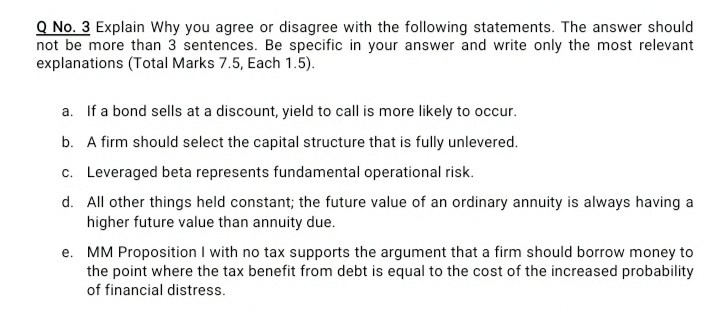
Explain Why you agree or disagree with the following statements. The answer should not be more than 3 sentences. Be specific in your answer and write only the most relevant explanations
If a bond sells at a discount, yield to call is more likely to occur.
A firm should select the capital structure that is fully unlevered.
Leveraged beta represents fundamental operational risk.
All other things held constant; the future value of an ordinary annuity is always having a higher future value than annuity due.
MM Proposition I with no tax supports the argument that a firm should borrow money to the point where the tax benefit from debt is equal to the cost of the increased probability of financial distress.
Assume you are a portfolio manager at JS Global Capital Ltd. Recently you came across three attractive stocks and want to create a portfolio investment in these three stocks. The details of the stocks are given below: Company name Volatility (Standard deviation) Weight in Portfolio Correlation with the market portfolio Meezan Bank Ltd 0.25 12% 0.40 Lucky Cement Ltd 0.35 25% 0.60 KE Ltd 0.40 13% 0.50
The expected return on the market portfolio is 8% and its volatility is 10%. The risk-free rate based on the central bank’s discount rate is 3%. (1.5 marks each)
a. Calculate each of the stock’s expected return and risk (beta) as compared to the market. b. What should be the expected return of the portfolio based on values calculated in part a. c. Calculate the beta of the portfolio? what does it tell regarding the riskiness of the portfolio? d. Using the values from part c, can you calculate the expected return of the portfolio? Is it similar to your answer in part b? Why or why not?
Assume you are a portfolio manager at JS Global Capital Ltd. Recently you came across three attractive stocks and want to create a portfolio investment in these three stocks. The details of the stocks are given below: Company name Volatility (Standard deviation) Weight in Portfolio Correlation with the market portfolio Meezan Bank Ltd 0.25 12% 0.40 Lucky Cement Ltd 0.35 25% 0.60 KE Ltd 0.40 13% 0.50
The expected return on the market portfolio is 8% and its volatility is 10%. The risk-free rate based on the central bank’s discount rate is 3%. (1.5 marks each)
a. Calculate each of the stock’s expected return and risk (beta) as compared to the market. b. What should be the expected return of the portfolio based on values calculated in part a. c. Calculate the beta of the portfolio? what does it tell regarding the riskiness of the portfolio? d. Using the values from part c, can you calculate the expected return of the portfolio? Is it similar to your answer in part b? Why or why not?
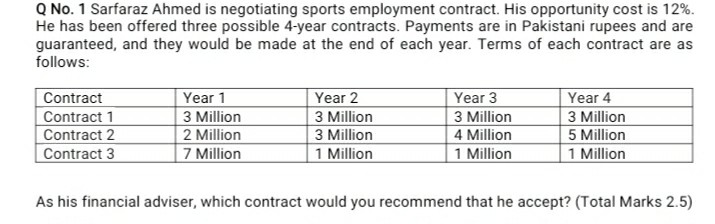
Q No. 1 Sarfaraz Ahmed is negotiating a sports employment contract. His opportunity cost is 12%. He has been offered three possible 4-year contracts. Payments are in Pakistani rupees and are guaranteed, and they would be made at the end of each year. Terms of each contract are as follows: Contract Contract 1 Contract 2 Contract 3 Year 1 3 Million 2 Million 7 Million Year 2 3 Million 3 Million 1 Million Year 3 3 Million 4 Million 1 Million Year 4 3 Million 5 Million 1 Million As his financial adviser, which contract would you recommend that he accept? (Total Marks 2.5)
Q No 5 Fauji Fertilizer Corporation expects to generate the following free cash flows in the coming 5 years. Year FCF (Rs. Million) 1 51 2 70 3 77 4 72 5 80 After this time period, the free cash flows will grow constantly at 3% per year. The firm's cost of capital is 13%. Using the discounted free cash flow model, calculate the following. a. What is the enterprise value of Fauji Fertilizer Ltd? (2.5 marks) b. If Fauji Fertilizer has access cash of Rs. 32 million, the debt of Rs. 280 million, and the 40 million shares outstanding and trading in the market, what should be the expected share price of Fauji Fertilizer? (2.5 marks) c. Suppose that the stocks of Fauji Fertilizer are being sold in the market at Rs. 12 per share. Will you buy that stock? why or why not? (1 mark)
Q No. 3 Explain why you agree or disagree with the following statements. The answer should not be more than 3 sentences. Be specific in your answer and write only the most relevant explanations (Total Marks 7.5, Each 1.5). a. If a bond sells at a discount, yield to call is more likely to occur. b. A firm should select the capital structure that is fully unreversed. C. Leveraged beta represents a fundamental operational risk. d. All other things held constant; the future value of an ordinary annuity is always having a higher future value than annuity due. e. MM Proposition I with no tax supports the argument that a firm should borrow money to the point where the tax benefit from debt is equal to the cost of the increased probability of financial distress.